
Categories
Latest Post

In the past, our water naturally contained minerals like calcium, magnesium, and potassium, thanks to...
No posts found
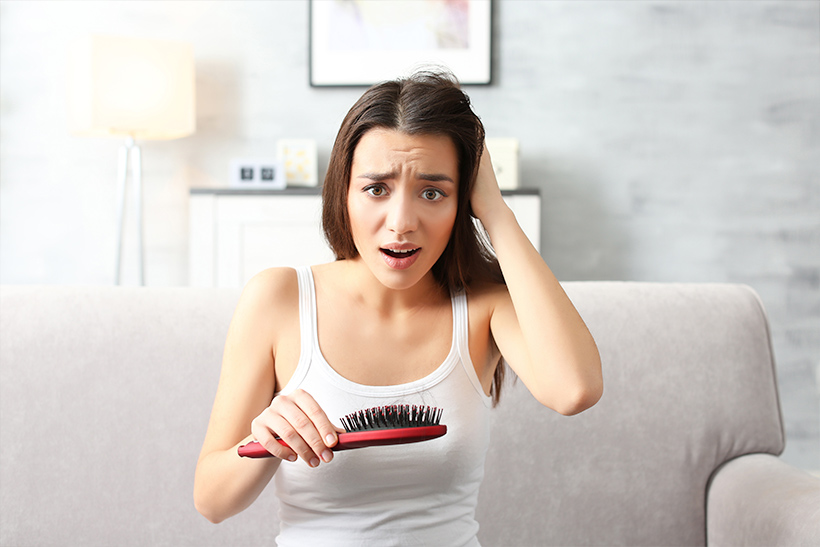
More and more women are writing to me asking, “Why is my hair falling out?” They notice strands on their pillow each morning. Others find their hairbrush full of hair. Unlike men – who often seem to accept hair loss with relative ease – hair loss in women carries social implications that can be deeply distressing.
So let’s explore the reasons behind hair loss – and what you can do to slow it down and encourage the regrowth of healthy hair.
Side Effects of Medications
Check whether hair loss is listed as a side effect of any medication you’re taking. Wikipedia can be a helpful resource for reviewing your drugs – looking into interactions, side effects, and contraindications. If hair loss is a known side effect, talk to your doctor about possible alternatives.
Factors That Influence Hair Loss: Stress, mineral deficiencies, hormonal imbalances, and a nutrient-poor diet.
Q: What does Dr Dean think about the link between magnesium deficiency and hair loss?
Dr Dean: What does it mean when hair loss is triggered by a major stressor, like surgery or childbirth? When the body is severely stressed and nutrient-depleted, hair loss typically appears three months after the event. If those lost nutrients aren’t replenished, the shedding continues.
Q: Can I apply ReMag® directly to my scalp while also taking it in water?
Dr Dean: ReMag® magnesium can help prevent hair loss, but in many cases, hair thinning is also related to thyroid imbalance. That’s why I recommend combining ReMag® with ReMyte®, which supports thyroid function. We’ve had many people report that once they started ReMyte®, their hair stopped falling out and began to grow back. For hair loss, the healing protocol is ReMag® plus ReMyte®.
Q: My hair is falling out a lot. My hairbrush is full every time I comb my hair. Sometimes I even notice strands falling out while sitting at work or at dinner. My doctor says it’s due to DHT. Can magnesium help? Can it stop the hair loss? Is it hormones? Is it just a life change? And what about hot flashes?
Dr Dean: Though this woman didn’t mention her age, it sounds like she’s in menopause and experiencing hair loss. Her doctor blamed it on DHT (dihydrotestosterone). Let’s unpack that – because it involves hormonal imbalances and what I call endocrine disruption, particularly in women with PCOS (polycystic ovary syndrome).
It all comes down to the trio of thyroid, adrenals, and sex hormones. In the thyroid: often Hashimoto’s or low thyroid function. In the adrenals: fatigue or burnout. In reproductive hormones: PMS, menopause, perimenopause… but I’ve long overlooked PCOS as a major factor.
In PCOS, the root problem is low progesterone and relative estrogen dominance. Progesterone is a precursor to cortisol, the stress hormone made by the adrenals. Chronic stress converts your progesterone into cortisol, depleting it even further. This contributes to infertility and miscarriage in PCOS, as progesterone is essential for maintaining early pregnancy.
Hair loss in women is often triggered by elevated insulin, which in turn stimulates excess testosterone. This happens when the diet is high in sugar and processed carbs. More sugar → more insulin → more testosterone → more hair loss, facial hair, and sometimes acne.
In PCOS, ovarian cysts form when hormones are out of balance and eggs are not released. These cysts compound the hormonal chaos in a vicious cycle.
To break the cycle, stabilise insulin by cutting out sugars and simple carbs.
Now let’s talk about DHT, which her doctor mentioned. DHT is derived from testosterone and binds to receptors in hair follicles, shrinking and “choking” them. Normally, sex hormone-binding globulin (SHBG) binds testosterone, keeping it in check. But high insulin suppresses SHBG, allowing testosterone to convert freely into DHT, accelerating hair loss.
This is how complex the body is – everything affects everything else. And yet doctors often prescribe a drug that targets just one thing, expecting it to fix the entire system. That’s not how the body works. PCOS is a perfect example of total body burnout.
A diet rich in natural phytoestrogens – like chickpeas, corn, lentils, beans, legumes, and flaxseeds – can help increase sex hormone-binding globulin, which binds excess testosterone.
And of course, there’s magnesium. Low levels of magnesium ions – and a high calcium-to-magnesium ratio – are directly linked to insulin resistance. Insulin is essential for allowing glucose into cells, but it only works if those cells have enough magnesium. Without it, insulin can’t do its job, and the body keeps producing more in an attempt to push sugar into the cells. Magnesium is therefore essential for proper insulin function.
By adjusting your nutrition and supplementing with ReMag® and ReMyte®, there is real hope that you can restore healthy hair growth.
— Dr Carolyn Dean
Warning!
This website is for informational purposes only and is not intended as a substitute for professional medical advice.
Disclaimer!
We do not treat, diagnose, cure, or attempt to prevent any diseases, and no advice or customer testimonials shared in reviews should be interpreted as evidence of specific health outcomes from using our products. Results may vary. Nothing stated on this website is intended to replace medical advice, prevention, or treatment.